
Some brands still see music as a secondary accompaniment. That bland music from a free bank for a video. That track has nothing to do with the brand or the message that the community manager chose for you. The cousin of the account guy who is a DJ for the annual convention.
And then some understand that there can be a real competitive advantage there: something that helps a brand differentiate itself, be better remembered, be perceived with greater depth, and build a stronger emotional bond with its audience.
The difference between one thing and the other lies in how sound is thought about: in the strategic direction, clarity, and certainty that turn sound into competitive advantage, emotional connection, and recognisable identity.
Music is not worked on to be cool, but to shape brand perception. To make an experience more recognizable. To reinforce an identity. To create a memory. To build a territory of one’s own in the middle of a market saturated with visual stimuli, repeated messages and tones already tiresome.
Most sectors are already quite crowded with brands that resemble one another. They resemble each other in aesthetics. In discourse. In language, tone, attitude, innovation, sustainability or creativity. They even resemble each other in the kind of images they use to seem different.
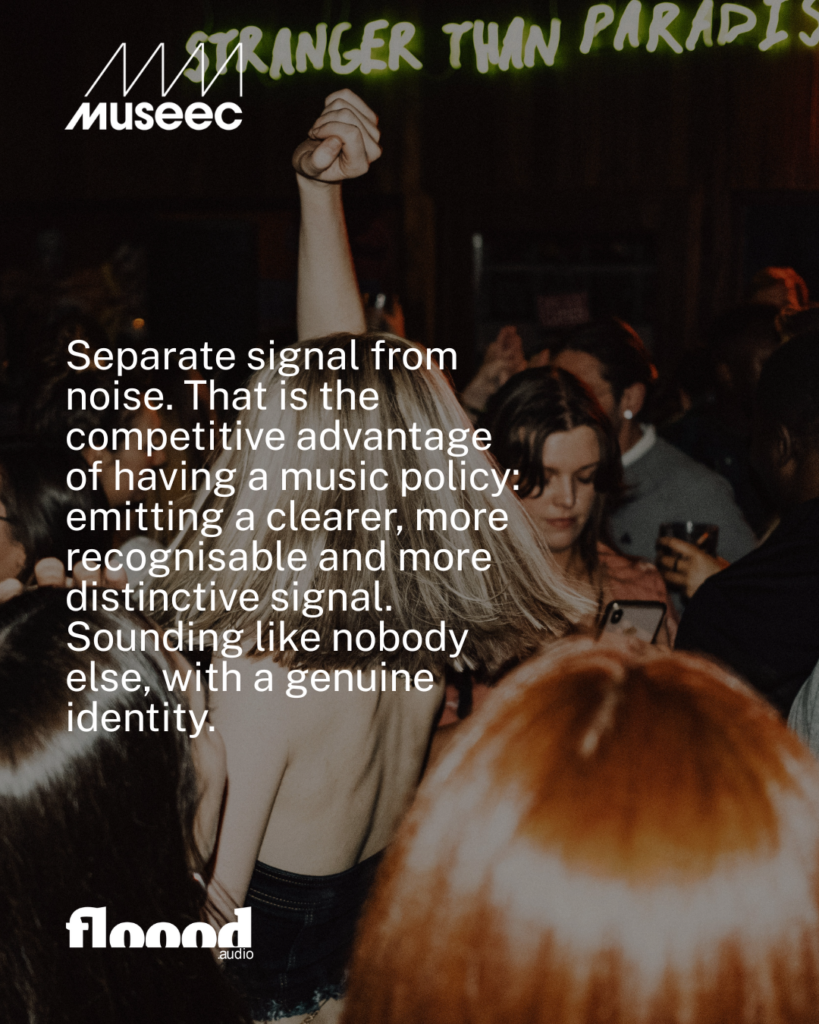
That is where music can open a very interesting space. Music is still underused as a system of differentiation. And that means a brand that handles it well can gain an advantage that is not easy to copy. It is not enough to copy a colour palette or a visual aesthetic. A well-defined musical territory implies culture, sensitivity, criteria, adaptation to context and a real understanding of how an experience is built.
Turning music into a competitive advantage does not mean composing a jingle for a radio spot. Nor does it mean using a couple of impactful songs in specific campaigns. It means designing a sonic ecosystem that reinforces who you are across different touchpoints: spaces, activations, content, events, audiovisual, retail, hospitality, or digital experiences. Whatever forms part of your universe.
That is to say: using music as a language coherent with that whole universe. When that happens, several things happen at once.
The brand gains personality, and the message is reinforced. It even becomes resignified and acquires a new life. Your spaces gain atmosphere (both physical and digital). The experience gains impact and memorability. The audience connects more directly and unconsciously with what the brand represents. And all that translates into something the market does notice: more singularity, more closeness, more coherence, more memory, more desire and, many times, more impact.
Because well-thought-out music can make a brand seem more sophisticated, more human, warmer, more alive, riskier or more culturally relevant. It can also help occupy a very concrete emotional place in the public’s mind and body.
And that is worth a lot.
It is worth it for a premium brand that does not want to sound empty.
It is worth it for a hotel that needs the experience to live up to its narrative.
It is worth it for an institution that wants to update its relationship with audiences.
It is worth it for an agency that needs a campaign to have more soul.
It is worth it for an administration that wants to build a real bond with its territory.
At FLOOOD we conceive music as an ecosystem: a living network of relationships that transforms how a space is perceived, how an audience behaves and what kind of emotional bond may arise.
And the competitive advantage is not in making more noise. It is about emitting a clearer, more recognisable, and more your own signal.
In sounding like no one else and with an accurate, clear message. Or, rather, in sounding like yourself at last.
Are you consciously deciding on music in your brand universe? Do you think it can be a competitive advantage?

Comments are closed