Music has a peculiar power that most people recognize long before they can explain it. A few notes can shift the mood of a room, bring back a forgotten period of life, intensify grief, soften anxiety, or make a moment feel larger than it is. Unlike many other art forms, music often works with extraordinary speed. It does not need to be translated into concepts before it begins to affect the body and mind.
Part of that force comes from the way music is processed in the brain. Listening is not a passive act of receiving sound. The auditory system transforms vibrations into neural signals, and those signals are then interpreted by a wide network that includes the auditory cortex, motor regions, language-related areas, and parts of the limbic system associated with emotion and memory. In other words, music is not handled by one isolated “music center.” It is woven into multiple systems at once.
This helps explain why musical experience can feel so total. Pitch, rhythm, loudness, timbre, harmony, and melodic progression are processed through partially distinct but interacting circuits. Rhythm, for instance, is closely tied to movement and anticipation, engaging motor planning and coordination. Melody and harmony, meanwhile, are strongly linked to pattern recognition, expectation, and emotional coloring. The result is that music is rarely just heard. It is also anticipated, embodied, and remembered.
Emotion is central to this process. The limbic system, including structures such as the amygdala and hippocampus, plays an important role in the emotional charge of music. It helps explain why certain passages feel pleasurable, tense, melancholic, expansive, soothing, or euphoric, and why music is so often bound to personal associations. Reward pathways involving dopamine are also activated in musically significant moments, which is one reason a song can feel not only moving but physically compelling.
Memory enters almost immediately. Musical perception is shaped not only by what is being heard in the present, but also by learning, attention, prior exposure, and emotional context. The brain is constantly comparing incoming sound with stored experience. That is why familiarity matters so much in listening: remembered patterns help people anticipate what is coming next, and anticipation itself becomes part of the pleasure. It is also why music can trigger recollection with unusual vividness. A song does not simply remind someone of the past in an abstract way; it can reactivate scenes, sensations, atmospheres, and states of mind with startling precision.
This connection between music and memory is especially striking because musical memory often proves remarkably resilient. Songs from childhood can bring back emotions and images more vividly than photographs, and they point to cases in which people with major memory loss still respond strongly to music or retain songs when other forms of recognition have weakened. The explanation offered is that music is distributed across multiple brain areas rather than stored as a single isolated trace.
There is also an important difference between types of listening. Sometimes music is the foreground, the object of full attention. In those moments it can intensify reflection, emotion, absorption, and even group identity. At other times it remains in the background, shaping atmosphere without becoming the center of consciousness. Yet even then it can still affect mood, pace, behavior, and the overall reading of a situation. This is one of the reasons music is so influential in restaurants, stores, events, and everyday environments: it does not need to dominate attention to alter experience.
What complicates the picture, and makes it more interesting, is that music is both subjective and partly predictable. Personal history, culture, mood, and individual associations all shape how people respond. The same song can move one listener deeply and leave another untouched. At the same time, certain musical features do tend to produce recurring kinds of response. Tempo, tonal character, dynamic range, density, and rhythmic behavior can reliably influence arousal, calm, excitement, tension, or introspection. Good musical decision-making, whether artistic or applied, depends on balancing these two realities: the psychology of broad patterns and the irreducible uniqueness of individual listening.
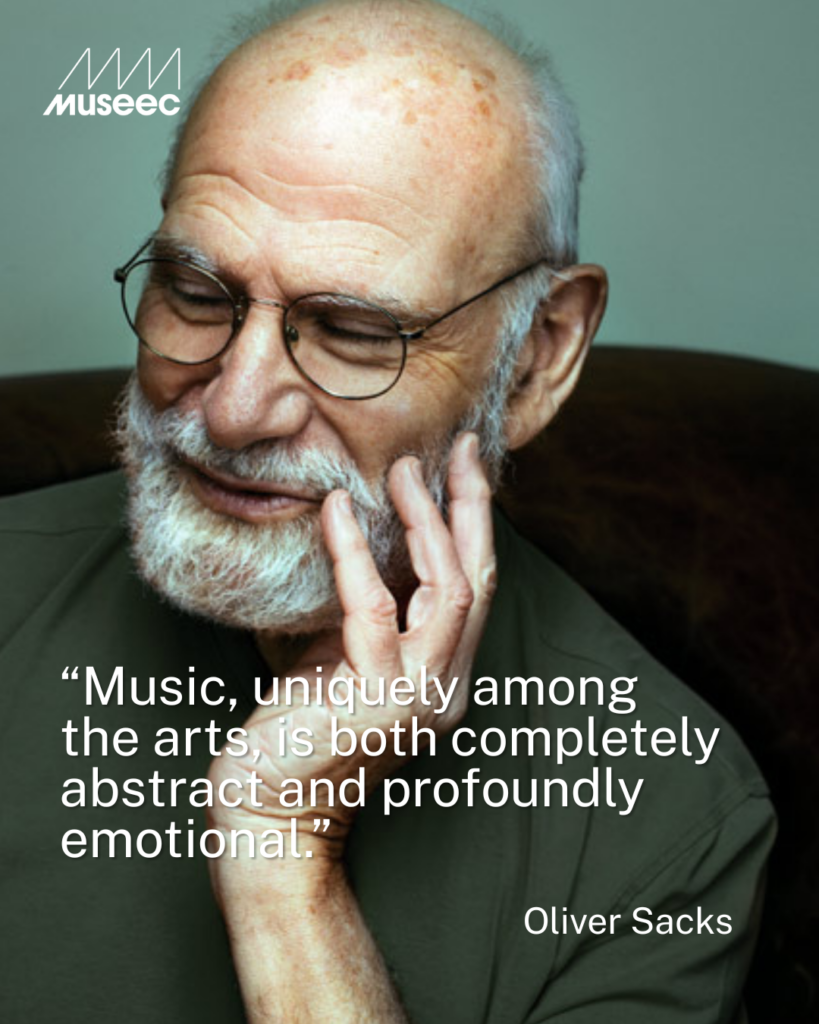
This is why music matters so much beyond entertainment. When used with care, it can support concentration, shape ritual, regulate energy, reinforce belonging, and build atmosphere with extraordinary efficiency. It can help a public space feel relaxed or alive, make an event feel coherent, intensify a filmic narrative, or transform the identity of a room. It can also act as a technology of the self, helping people process grief, manage mood, or remember who they are in certain moments of life.
Perhaps that is the deepest reason music remains so powerful. It does not just represent emotion from a distance; it often behaves like emotion in sound. It moves through time the way feeling does: building, suspending, releasing, returning. And because it binds itself so easily to memory, it often stays with people long after the moment has passed. A space may be forgotten. A conversation may blur. Even an image may fade. But a song attached to a lived moment can remain vivid for decades.
That is why music continues to play such an outsized role in human life. It is not only a soundtrack added on top of experience. Very often, it becomes one of the ways experience is felt, organized, and remembered in the first place.




Comments are closed